Thursday, October 1, 2020

Yes, That's Really Its Name


Last week, right after Hurricane Sally, a brown booby was spotted several times at Lake Strom Thurmond, near McCormick.  Okay, reader, we’re not making this up.  This is a real bird that really did come to the lake.  I have no idea how it got its name, but that’s what it is.  And now that we have taken care of that small detail, we can continue.


According to the range maps, the brown booby is not supposed to be found north of Miami.  This is a large seabird, living its life in tropical ocean waters worldwide.  It nests on Caribbean or other sea islands, or sometimes on sea debris large enough to support a nest.   Its back and upper parts are brown, with white underparts, and it has a large bluish bill.  


Occasionally a stray finds itself further north, usually because of a hurricane or other strong weather system.  Four years ago, another brown booby stayed at the Lake Strom Thurmond dam for two weeks.  This caused quite a stir among the local birding community, and many Carolina birders were able to go to the overlooks at the dam to view this unusual bird.


One Friday afternoon, I talked Mike into going to try to see it.  The drive was a haul, going through tiny towns on two-lane roads for a couple of hours.  However, the observation was not to be.  The winds were horrendous.  I could barely hang onto my binoculars, or even myself, on the rocks at the edge of the lake.  We scanned the shore and the bridge for a long time, and drove around to other places with views of the lake, but never did see it.  We did come home through Abbeville and got a nice meal, so the trip was not all in vain.  


In 2018, another brown booby was found in the upstate - this one in Greenville, near the bell tower on the lake at Furman.  This bird hung out for most of the month of May, apparently completely blown off course and not sure what to do or where to go.  It was not shy and even seemed like it was posing for pictures. It’s very unusual looking with its large bluish bill, and we enjoyed the treat of seeing a seabird so far out of its range.  We got several good photographs, as did many other local people who came to see it, before it finally disappeared to who knows where. 


So there you have it - the brown booby, seen occasionally in the upstate.  The story behind the snicker.  You may now return to your regularly scheduled serious reading.

Why Should I Write About Robins?

 “I think you ought to write about robins,” Mike said randomly one day. Robins! Why in the world would he think robins!  Robins are just--there.  They are one of the most common birds around Anderson and across the entire country - just look at a range map in a field guide or on the internet.  Everywhere. 


While thinking about robins, I contacted a bird photographer acquaintance to see if he had a robin photo.  He doesn’t have one, because “I guess I took them too much for granted.”  Exactly.  Why should I write about robins, when other people are unimpressed, and many other species are so much more unusual and interesting?


Maybe I’ve never been too excited about robins because their appearance is somewhat nondescript--just dark grey and dull orange.  However, at least one robin color could simply be personal prejudice.  At the risk of alienating some readers -- Mike and I are not too crazy about the color orange, if you get my drift.  


I remember as a child of four or five looking out our front window at a robin on our lawn, and my mother explaining to me that they were one of the first birds of spring in our Illinois yard.  Even though in more northern states they’re considered to be harbingers of warmer weather, here in South Carolina we see them year round.  January robins don’t exactly impress us that spring is about to arrive.


Robins do have a pretty song, which like most birds is most often heard in the spring.  Their song is similar to a bluebird’s, because both are thrushes, a bird family known for melodic singing.  They are familiar sights in urban yards, running short distances and then stopping to look and listen for worms.  We all have a mental picture from childhood storybooks of a robin pulling up a worm from the ground--even if it’s not something that we actually observe very often.  


Which leads me back to the question:  “Why should I write about robins?”  I asked Mike.


“Well, look at them,” he said as he glanced over our rain-soaked yard.  Robins were everywhere, spread out over the lawn.  Each was intently working its area, watching and listening for dinner.  “They’re perfect to write about now.  They’re great examples.”


I looked at him through unconvinced eyes, wondering again what kind of crazy idea was going through his mind.  “And in what possible way are robins good examples?!” I asked.


“They’re smarter than you think.  They’re great at social distancing.”


And sure enough, they were perfectly spaced out, at least six feet apart, as if they were following the rules.  Socially correct birds - a perfect topic for these COVID days.  I think I’ll write about robins.

Orchard Orioles and the Unexpected


I’ve learned not to have an agenda for what to find when seeing or listening for birds. It’s a little like going to yard sales.
  If I’m specifically looking for a white wicker basket, none will be found in a radius of twenty miles.  However, I had better be on the lookout for just about anything - because otherwise I might overlook the like-new throw rug that is perfect for my porch.  It’s the same with birdwatching.  Always be on the lookout for the unexpected bird that turns out to be something special.


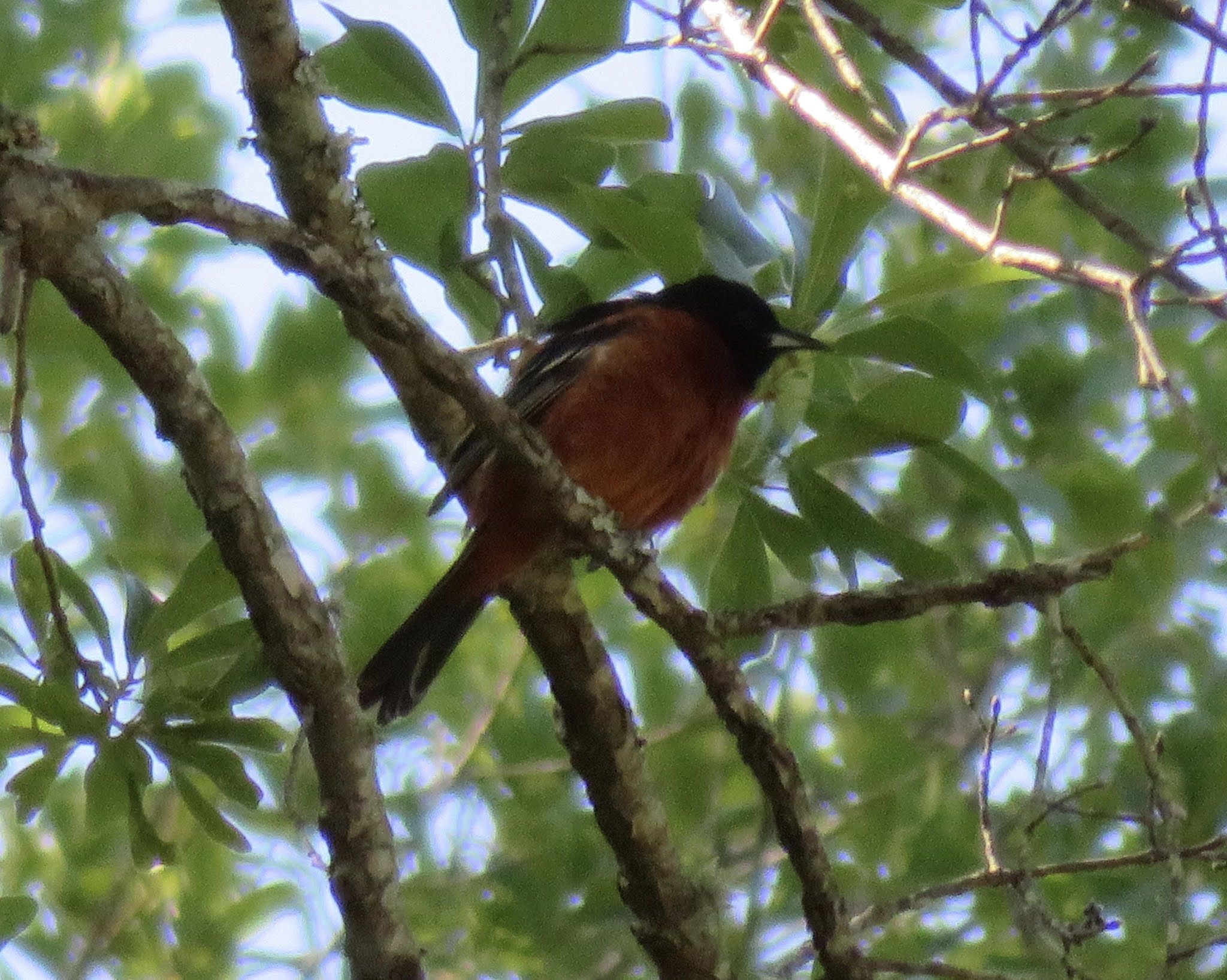
That’s where the orchard oriole comes in.  Most people are unfamiliar with this pretty bird.  I have never set out to find an orchard oriole, which is pronounced by bird guides to be “fairly common” in the upstate.  They are lesser-known cousins of the flashier Baltimore orioles, which are black and brilliant orange, and which migrate through our area on the way to their more northern nesting grounds.  The orchard oriole does nest in upstate South Carolina.  The male orchard looks almost identical to a Baltimore male except in its hue of orange: the Baltimore is bright, but the orchard’s shade is much rustier and more subtle.  Females of both species are greenish-yellow, although Baltimore females may be more orange-tinted.


We’ve unexpectedly run across orchard orioles three times in our years of wildlife-watching adventures:  the first one at Huntington Beach State Park, one while on vacation at Debordieu Colony near Georgetown, and the third one just a few weeks ago on our farm property.  Mike and I were relaxing in the open doorway of the barn, enjoying the afternoon breezes.  I was certainly not particularly expecting to see one of these beauties, but an orchard oriole, like many other less common birds, tends to sneak in when a person has no idea it is coming.  


I saw a brief flash of something moving into the trees to my left; at first I thought it was all black, like a grackle, and then realized that this bird also had some color to it.  It lit on a branch where it could be seen, and a look through binoculars confirmed that it was an oriole.  A second look confirmed its rusty color.  And fortunately it stayed long enough that I could get my sometimes cantankerous camera focused on it and get a picture.  It stayed in the tree for a few minutes - and then it was gone.  If we hadn’t been on the lookout for movement in the trees, we would have never known it had been there. 


Finding something I don’t plan to find at a yard sale is always fun.  And that brief unplanned glimpse of an orchard oriole in our trees was fun also--a splash of beauty in an otherwise ordinary day.  It was all the evidence I needed to keep watching for the unexpected.


Thursday, July 23, 2020

Killdeer Chicks and Blueberry Threats


Of course this was the morning that I forgot my good camera, when I could have gotten great pictures of a mama killdeer rescuing her chicks from a big, bad threat.

Mike and I were picking blueberries, deep in the bushes that we inherited with our farm purchase a year ago.  (36 gallons of berries gathered so far.)  I was down on my low stool, getting the hidden gems at the bottom, when I heard our resident killdeer make her characteristic “che-ee” sound from the old garden area to our left.  She must have been teaching her chicks to spread their wings a little, because this was quite distant from their usual home in the woods and water hole near the entrance of the property.  But now she had detected peril.  Two tall creatures were in the blueberry bushes, and too close for comfort! One was even wearing a floppy hat!  This was dangerous.  She continued her noises, worked on a plan, and stayed close to protect her chicks.

Mike made his own human version of the “che-ee” sound, which must have worked, because as I continued collecting low-hanging berries, I could hear the mama moving toward us, but coming in a wide arc around the bushes and at a safe distance away. And following her, here came the three chicks making much lighter and softer sounds.  When I stood up I could see two of the little ones had made it to the gravel to my right, heading with determination for home and stopping every second or so, the way killdeer move when they’re checking out their surroundings.  And Mama was alongside on the low deck beside them, chaperoning their travel.

But trouble was brewing.  The third chick got turned around, and instead of heading for home, was moving straight toward the wall of the barn instead.  Mama was worried.  Her cheeping sounds got louder and more intense.  

And then, even as his siblings were approaching safety, the stray chick got even more confused, getting behind the four-wheeler instead of turning toward home. Mama was not leaving him.  Her calls got more urgent, doing everything possible to get him going in the right direction.  We kept picking berries, but the unfolding sight was too interesting to ignore.

Finally, success.  Mama slowly got the little one turned in the right direction.  The two ran with their typical intermittent killdeer motion across the deck, properly pointed toward the watering hole.  They scooted across the gravel and made it to the woods.  The silence told us that Mama was no longer upset and that all three babies had made it to safety from those big, bad, blueberry-picking threats.

The killdeer were safe and happy.  We got two more gallons of berries.  Even if the camera did get left at home, it was a good morning.

Friday, July 17, 2020

American Goldfinch - Brilliant Bird of Mid-Summer


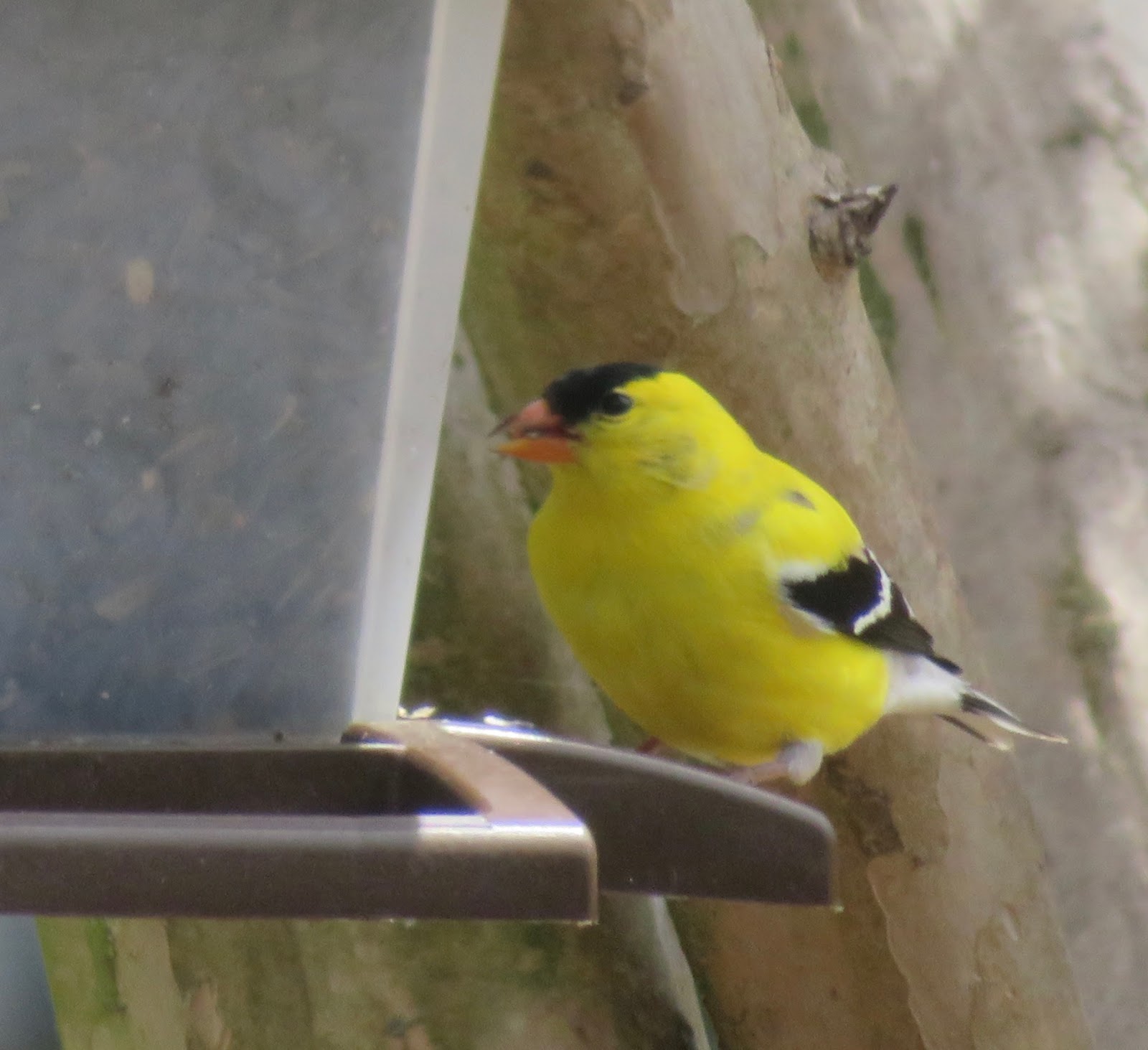
The local bird of mid-summer has to be the American goldfinch, which has been compared to a flying stick of butter.  It’s about that size, and its color is similar, although brighter.  A glimpse of a breeding male goldfinch will take a first-time observer’s breath away. It is brilliantly yellow, and brilliant is an understatement.  This bird is colored a yellow that is so intense that the first time someone sees one, he is not sure that he’s really seen a natural bird.  Yes, it’s that bright.  And that beautiful.

In addition to the bright yellow color, a breeding male has a black patch on its forehead that looks like a jaunty cap topping it off, and its jet-black wings also complement its color perfectly.

By July most birds are winding up their nesting and raising young for the year.  Not so with the American goldfinch.  It’s just getting a good start.  That’s because they like milkweed and thistle, plants that come out later in the season.  The goldfinches incorporate these seeds into their nests as well as feed them to the young birds.  The beautiful design of  goldfinches allows them to reproduce when milkweed and thistle seeds are more prominent.

One way to attract goldfinches is to hang a bag of nyger seed, which is a great substitute for thistle.  Nyger is sterilized (to prevent it from germinating), and net bags of this tiny seed are easily found at hardware and grocery stores.  If the seed is relatively fresh, goldfinches will almost mob it at times.  They are picky, however.  If they ignore a nyger bag, the seed is probably old, and the birds won’t come to it.  They also come to sunflower seed in feeders year-round.

The contrast between a breeding male and a winter male is striking.  In the winter, a male goldfinch is drab – a grayish brown color with gray-black wings and a hint of yellow, almost indistinguishable from the female, who is grayish brown and yellow year round.  But around the end of March, the male’s bright breeding color begins coming in.   Soon it has taken on the lemony butter hue for which it is so well known. 

These birds are common around our area.  Anyone who keeps eyes open has a good chance of seeing one out in open areas.  Even after many years, I still find it a mid-summer treat to look up and see the undulating flight of a pair of goldfinches, the bright yellow of the male leading the way as the two dip and rise through the spring and summer sky.  

Mockingbird - Singing Its Heart Out


Anyone familiar with Harper Lee’s famous book To Kill a Mockingbird knows that Atticus tells his daughter Scout that it’s a sin to kill one of these birds, and neighbor Miss Maudie further explains, “Mockingbirds don’t do one thing but make music for us to enjoy . . . they don’t do one thing but sing their hearts out for us.”

Well, Miss Maudie is right that mockingbirds do sing.  Extensively.  A mockingbird has one of the clearest and most obvious singing voices in the bird world.  And at times they don’t limit their singing to the daytime.  Not long ago a friend posted a video on Facebook that she had taken close to midnight one evening.   The video was completely black, but the audio was a mockingbird in full singing mode. “Isn’t this bird ever going to be quiet?” she asked in desperation.  

Mockingbirds are one of our most common bird species, seen regularly on power lines and fences, in neighborhood yards and urban parks, and over open country fields.  They can be observed irritating crows in flight.  They have an understated beauty with their sleek pearl-gray, dark gray, and white coloration.  Mockers have long slim bodies, and are easily recognized when flying because of the white patches on their wings and down both sides of their tails.

Mockingbirds are mimics with great ability to copy other birds’ songs.  Once while on a lunch break at a summer job in Greenville, I counted 20 song changes from a mockingbird, without a single repeat.  And the various calls continued after I had to go back inside.  While a few other birds also do some mimicking, none have the extensive repertoire of this gregarious bird.  

Most people think that the mocker sings for the sheer pleasure of singing.  However, it has much stronger reasons for its outbursts of song.  The mockingbird is extremely territorial and will aggressively defend its area.  But a mockingbird does not sing year-round -- it limits its vocalizations to spring and fall.  In the spring and early summer it is setting up territory for nesting, and in the fall it is setting up its winter boundaries.  A careful observer will notice that, as it sings, the mocker flies from perch to perch around the perimeter of the area it has chosen.  

And therein lies the rub with Miss Maudie’s explanation. Yes, this bird sings and sings, appearing to vocalize its heart for our pleasure.  However, the mockingbird’s song is not so much a joyful cry as it is a warning to all other birds:  “Stay away!  This area is mine!”

Painted Bunting - Jewel of the Beach

Painted Bunting - Jewel of the Beach


Years ago, Mike and I pooled our change, took our baby on a whirlwind two-night beach trip, and stayed at a beyond-rustic little inn on Pawleys Island that would be swept away two months later in Hurricane Hugo.  (“Breakfast Included” at this place meant we got a Styrofoam bowl with some cereal and milk.)  On a car trip exploring the area, we somehow wandered into the back part of Litchfield Plantation and were attempting to turn around in the maintenance parking lot - when a flash of bright colors landed in a bush right in front of us.  “Mike!”  I exclaimed (if you can “exclaim” in a whisper), “Painted bunting!”  It was a life bird for both of us and was the highlight of that brief run to the beach.  We’ve been privileged to see a number of them since then.

Painted buntings are the jewels of the beach.  Their bright colors - blue head, yellow-green back, and red underparts - make the males unmistakable and unforgettable.  The females are yellow-green only, and though not as flamboyant as males, are still pretty.  These beauties used to be seen strictly along the coast and only in the summer, but their range has been expanding so that sometimes they are seen as far inland as Columbia (as well as expanding upward from Texas into the Midwest), and some are even staying year-round near the coast.  

You can find painted buntings at the beach, but you won’t find them while sunning along the tide line. Buntings like scrubby areas, so as you are taking your bicycle or golf cart ride or walking around your area, look for undeveloped places filled with brush and bushes.  With vigilance you have a good chance of seeing one in this habitat.  They also like to sing from exposed perches, so you may hear their lovely song from above before you see them.  Keep your binoculars handy.

A great place to see painted buntings in the summer - we have never failed to see one here - is at Huntingdon Beach State Park in Murrells Inlet.  Enter the park, cross the causeway, and take a left.  Check out the bird feeder at the observation deck on your left, across from Sandpiper Pond nature trail parking lot - that feeder is usually filled with white millet, a favorite of painted buntings.  Continue driving slowly down the road toward the beach access, listening for a beautiful trilling song and keeping your eyes on the exposed perches at the tops of trees.  On a hot summer day, you have a great chance of seeing one of these beautiful birds.

And, no matter how fancy or rustic the place where you are staying, if you are a bird enthusiast, finding one of these summertime jewels will be the long-remembered crowning touch of a beach trip.