Saturday, February 13, 2021

Northern Harrier vs. Progress


 Female Northern Harrier, 1/2021

I first saw a northern harrier several years ago in the large triangular field bounded by Whitehall Road and Highways 24 and 187 in west Anderson.  It’s an uncommon hawk for South Carolina, present only in the winter, but often visible if an observer goes looking for one in the open fields of our area.  The harrier’s defining field marks are its white rump (easily visible when it is flying) and its way of holding its wings at an angle when it flies.  Its body is slender.  It often sails with the wind currents, and also sometimes hovers over prey.


The harrier is large--about the size of a red-tailed hawk, which is a much more common hawk around here.  Also for comparison, the tail of a red-tailed hawk looks like a rusty fan, but the harrier’s tail is long and narrow. The female harrier is dark brown, and the male is pearl gray.


That bleak winter day, I pulled off to the side of the road and watched that sleek lovely bird for fifteen minutes or so, enjoying the beauty of seeing it sail back and forth on the wind currents above the waving grasses, as it looked for small mammals or any prey that pleased its fancy for supper. I’ve kept that memory ever since.


Then, within months, “progress” took over.  The field was bulldozed and leveled.  A shopping center was built.  A grocery store, a restaurant, several smaller offices, and a sea of asphalt replaced the waving grasses.  


I missed the beauty of the field, and seeing sights like that beautiful harrier - but did get used to the homelike atmosphere of the grocery. It was smaller and more intimate than the other groceries in the area. The deli workers always knew exactly how I wanted my order sliced. One of the checkout ladies would ask how my school year was going, and I would ask her about her children. The store was a welcoming and friendly oasis on a busy road.  Maybe this change wasn’t all bad.


And then--another form of “progress” occurred.  The grocery chain announced their business model: to close that lower-volume store (and others like it), so they could build new ones in different areas that might produce greater profit.  Since the grocery was the anchor in the center, the domino effect caused many of the other businesses to shut their doors as well.  


And now the grocery store is boarded up and quiet, and has been for a long time. Other smaller businesses come and go in the center, but some storefronts stand continuously empty. 


I don't know much about business models. I just know that a nice neighborhood grocery has been closed for several years now, and a large and beautiful field has been covered with a mostly unused parking lot.  And I also know that northern harriers don't search for their supper over asphalt and empty buildings.


Saturday, January 16, 2021

Old Observations

Found these in my files and thought I'd type them onto my bird blog since I've got time right now.

7-6-88 - We spent the morning fishing on the Saluda River in Newberry County.  About 7 am I saw my first prothonotary warbler when two of them swooped in front of our boat and landed in the trees on the bank.  I was able to study them with the binoculars and also several more that morning.

I studied the swallows under the 121 bridge and concluded that they are cliff, not barn, swallows.  The tails were definitely square; the breast cream colored, and the neck rust.  I couldn't see them well enough to see the forehead.

We also saw an anhinga.  A little out of range according to the books, but swimming with only neck and head exposed; long yellow bill; cormorant-like flight.  Maybe a double-crested cormorant?

We watched four egrets who kept retreating as we boated toward them.  We watched a beaver make two trips across the river.

7-8-88 - Last night while home alone I was awakened by a horrible screaming sound.  I slept fitfully, thinking something was happening to someone across the creek.  This morning Mrs. Waite said it was an owl of some sort who shrieks terribly.  The first shriek was in a tree by Kristen's window; the last four from the woods across the creek.  The only owl who shrieks like that that I could find was the long-eared, and it's a winter owl. ?   [EDIT:  It was a barred owl.]

8-20-88 - Saw an immature red-headed woodpecker on Moultrie Square in Anderson.  It had adult plumage but the head was not yet bright red.  We watched him peck for several minutes.

9-4-88 - On the drive to Newberry we saw a beautiful Canada goose silhouetted against a field.  [EDIT 1-16-2021: I now find that observation a little amusing.  Back then a Canada goose was a nice observation.  Now that they are commonplace, and somewhat obnoxious, I would never make such an observation.]

9-13-88 - Tonight as we got out of the car we heard a screech owl between the driveway and the road.  We stood very still and Mike imitated its call.  Within 15 seconds the owl flew overhead into the trees by the house!  Mike repeated the call and the owl called back to him several times.  In about a minute the owl flew back overhead to the woods by the road again.  I'd have loved to see its features, but even seeing its silhouette against the sky was exciting.

12-3-88 - As I was walking into the house, I saw two yellow-bellied sapsuckers working their way up the red maple in the front yard.  Also, a flock of cedar waxwings is passing over today, stopping in our trees - perhaps eating the holly berries?

12-15-88 - We hung the feeder a few days ago.  The titmice are back in full force, cleaning the tray daily.  Chickadees are here also, though not as many.  The white-breasted nuthatch also appears regularly, though not as often.  And occasionally I see a cardinal, a pine warbler, or a house since.  Juncos fly up sometimes to eat on the tray.  I thought they were exclusively ground feeders.

12-19-88 - We watched a red-tailed hawk swoop down to the median, capture a mouse, and fly back up, holding him in his talons.   P.S. - I read in the paper that there are so many hawks by interstates because the large population of mice in the median is inaccessible to foxes and other land animals there.

2-26-89 - Friday there was tremendous flocking behavior of robins around the Academy - Some grackles too.  They were eating holly berries - and they baptized my car.

Today (Sunday) we saw a loggerhead shrike on a wire outside of the Shealys' house in Newberry.  I got a good look at him through the binoculars.

The feeder has been busy, but with no new birds this year.  We have yet to see a pine siskin - probably because this has been a very warm winter.  The red-bellied woodpeckers, male and female, have been back - Sometimes the bluejays approach, and yesterday even a robin made a brief landing.  This year I've seen two and even three Carolina wrens at a time, eating seeds, and yesterday I saw three goldfinches in winter garb on there.  One had a standoff with a song sparrow.

4-6-89 - Yesterday for the first time I saw clearly the yellow lores at the eye of the white-throated sparrow.

Today at two separate times I watched robins carry twigs to their nests.  

The kids in my homeroom have picked out the song of a bird which they asked me to identify.  I think it's a song sparrow.  Very observant of them!

The cedar waxwings are returning.  I hear them every day.

5-30-89 - Last Saturday we finally saw one - a painted bunting.  It is even more brilliant than it appears in pictures.  We were on Litchfield-by-the-Sea, and we accidentally pulled into a remote maintenance area, when one flew across my view.  I yelled "Painted bunting!" and we both watched it land on a branch near us.  We both got beautiful views of it, both with binoculars and unaided, for about 2-3 minutes.  It was the highlight of our vacation to Pawleys Island.

On Sunday, at Barbara's house, I watched a redheaded woodpecker for several minutes - I hadn't seen one of them for three years, close-up, so that was a treat also.

6-30-89 - On the trip through Central Illinois last week I saw red-winged blackbirds along the interstate almost constantly.  There were many ponds, and each bird probably had his nesting area mapped out.  The red-wings to me are much more appealing than the grackles.

On the trip home, on the way to southern Illinois, I saw cattle egrets around a cluster of cows; and on one of the rivers I saw a flock of ducks - couldn't identify them but know they are not mallards because there was too much white on them.

Yesterday morning, in Alabama, Mother got me out of bed to see the unusual bird in the backyard drainage ditch.  It was very unsteady on its feet and had bright yellow legs and bill.  It was an immature of either a black-crowned or yellow-crowned night heron.  Mother got a better look and says it was a yellow-crowned, but the Golden book says they are much less common than the black.  It's hard to say which it was, but it was fun to see.  I'm glad Mom got me up to see it.

7-10-89 - Right in front of our car, yesterday as we pulled around Gaston to the nursery, we saw a brown thrasher angrily chase a chipmunk across the road!

7-30-89 - Saw a summer tanager out the window of the Summers' mobile home yesterday.

This morning as Andrew and I walked to the road to get the mail, we watched a robin take a mid-morning dip in a puddle in the driveway.

There are a number of flickers around right now and have been for several days.  I watched two of them "talking" to each other for several minutes in the front yard.  They were only about two feet apart on the ground.

12-19-89 - The pine siskin have returned to the feeder this morning - the first time they've been here in a couple of years.  

I'm fairly certain I saw a ruby-crowned kinglet a couple of weeks ago.

The red-bellied woodpecker dominates the feeder again this year.  Most of the other birds scatter or retreat to the far side when either the male or the female appears.

1-4-90 - On 12/23, Mike and I went to Wheeler Wildlife Refuge and spent over an hour studying the ducks.  Saw pintail, widgeon, mallards, black ducks.  Mike saw "scaup" but I never could identify them.  Also saw coots and Canada geese.  The paper said that 2,400 snow geese were also on the reserve, but I was unable to get back out there to try to see one.  Dad didn't think I should go alone; Mike was gone, and no one else could ever work it out to go with me.

Sunday morning, 12-31, I positively identified a ruby-crowned kinglet, outside the kitchen window in the bush, at Mom and Dad's house.

2-17-90 - Saw a pair of hooded mergansers in one of the creeks coming up from the ocean at Kiawah Island - then we watched a red-breasted merganser also.  Both were new to me; Mike had never seen the red-breasted though was familiar with the hooded.  They were beautiful ducks.

6-7-90 - Beautiful red-headed woodpecker living somewhere near Mark's house in Atlanta - we saw it several times out of the kitchen window.  Once it lit on the grass in the brilliant late-afternoon sun, and the contrasting colors were beautiful.

6-1-92 - Since the kids have come along this has really slipped.  Often I've seen things and made a mental note to record them - and then get caught up in the demands on my time.

    --Last fall:  Hooded mergansers spent several weeks on the two ponds behind Garrison's farm.  Mike said he'd never seen that large a flock - between 20-30 ducks.

    --A couple of weeks ago I identified the dickcissel near those same ponds.

    --Last night I saw a kingbird on a power line near the interstate bridge, the first I've seen in about three years.

    --A month ago:  Three deer feeding by the bridge early in the morning (7:30) scrambled for cover when I slowed the car.

    --This winter:  A large red-tailed hawk swooped low over our car at approximately the same place as where the deer were feeding.

    --I am re-enjoying the common birds again through the delight of teaching them to Andrew, who at age 3 is fascinated by their actions.  He gets very excited whenever he sees a robin - he knows a number of other species also.

Tuesday, October 13, 2020

Birds at Feeders 2020-21


Red-breasted nuthatch, 11/22/2020


American goldfinch with two pine siskins.  They often flock together.


Pine siskins 2/13/2021

Immature rose-breasted grosbeak, migrant, first bird seen at feeder in autumn 2020 (October)
  1. Rose-breasted grosbeak
  2. Carolina chickadee
  3. Tufted titmouse
  4. House finch
  5. Purple finch
  6. American goldfinch
  7. Pine Siskin
  8. Ruby-crowned kinglet
  9. Carolina wren
  10. Downy woodpecker
  11. Red-bellied woodpecker
  12. Northern mockingbird
  13. Brown Thrasher
  14. Blue jay
  15. Northern junco
  16. Palm Warbler
  17. Pine Warbler
  18. Orange-crowned Warbler
  19. Yellow-rumped Warbler
  20. Mourning Dove
  21. House sparrow
  22. White-throated sparrow
  23. Chipping Sparrow
  24. Northern Cardinal
  25. White-breasted nuthatch
  26. Red-breasted nuthatch
  27. Brown-headed nuthatch
  28. Baltimore Oriole
  29. Sharp-shinned Hawk
  30. Eastern Phoebe

Sunday, October 4, 2020

First Bird of the New Feeding Season

This isn't a great photo - taken through the window - but I had to upload it. Last year, though people all over Anderson SC were seeing rose-breasted grosbeaks, we didn't see a single one.

In August I took down our feeders to clean them and put them back up yesterday afternoon. I didn't see anything then. This morning, 10/4/2020, Mike says "There's something unusual at the feeders."  

Lo and behold, an immature male rose-breasted. Who would have thought that this would be our very first bird of the new feeding season!!


Thursday, October 1, 2020

Yes, That's Really Its Name


Last week, right after Hurricane Sally, a brown booby was spotted several times at Lake Strom Thurmond, near McCormick.  Okay, reader, we’re not making this up.  This is a real bird that really did come to the lake.  I have no idea how it got its name, but that’s what it is.  And now that we have taken care of that small detail, we can continue.


According to the range maps, the brown booby is not supposed to be found north of Miami.  This is a large seabird, living its life in tropical ocean waters worldwide.  It nests on Caribbean or other sea islands, or sometimes on sea debris large enough to support a nest.   Its back and upper parts are brown, with white underparts, and it has a large bluish bill.  


Occasionally a stray finds itself further north, usually because of a hurricane or other strong weather system.  Four years ago, another brown booby stayed at the Lake Strom Thurmond dam for two weeks.  This caused quite a stir among the local birding community, and many Carolina birders were able to go to the overlooks at the dam to view this unusual bird.


One Friday afternoon, I talked Mike into going to try to see it.  The drive was a haul, going through tiny towns on two-lane roads for a couple of hours.  However, the observation was not to be.  The winds were horrendous.  I could barely hang onto my binoculars, or even myself, on the rocks at the edge of the lake.  We scanned the shore and the bridge for a long time, and drove around to other places with views of the lake, but never did see it.  We did come home through Abbeville and got a nice meal, so the trip was not all in vain.  


In 2018, another brown booby was found in the upstate - this one in Greenville, near the bell tower on the lake at Furman.  This bird hung out for most of the month of May, apparently completely blown off course and not sure what to do or where to go.  It was not shy and even seemed like it was posing for pictures. It’s very unusual looking with its large bluish bill, and we enjoyed the treat of seeing a seabird so far out of its range.  We got several good photographs, as did many other local people who came to see it, before it finally disappeared to who knows where. 


So there you have it - the brown booby, seen occasionally in the upstate.  The story behind the snicker.  You may now return to your regularly scheduled serious reading.

Why Should I Write About Robins?

 “I think you ought to write about robins,” Mike said randomly one day. Robins! Why in the world would he think robins!  Robins are just--there.  They are one of the most common birds around Anderson and across the entire country - just look at a range map in a field guide or on the internet.  Everywhere. 


While thinking about robins, I contacted a bird photographer acquaintance to see if he had a robin photo.  He doesn’t have one, because “I guess I took them too much for granted.”  Exactly.  Why should I write about robins, when other people are unimpressed, and many other species are so much more unusual and interesting?


Maybe I’ve never been too excited about robins because their appearance is somewhat nondescript--just dark grey and dull orange.  However, at least one robin color could simply be personal prejudice.  At the risk of alienating some readers -- Mike and I are not too crazy about the color orange, if you get my drift.  


I remember as a child of four or five looking out our front window at a robin on our lawn, and my mother explaining to me that they were one of the first birds of spring in our Illinois yard.  Even though in more northern states they’re considered to be harbingers of warmer weather, here in South Carolina we see them year round.  January robins don’t exactly impress us that spring is about to arrive.


Robins do have a pretty song, which like most birds is most often heard in the spring.  Their song is similar to a bluebird’s, because both are thrushes, a bird family known for melodic singing.  They are familiar sights in urban yards, running short distances and then stopping to look and listen for worms.  We all have a mental picture from childhood storybooks of a robin pulling up a worm from the ground--even if it’s not something that we actually observe very often.  


Which leads me back to the question:  “Why should I write about robins?”  I asked Mike.


“Well, look at them,” he said as he glanced over our rain-soaked yard.  Robins were everywhere, spread out over the lawn.  Each was intently working its area, watching and listening for dinner.  “They’re perfect to write about now.  They’re great examples.”


I looked at him through unconvinced eyes, wondering again what kind of crazy idea was going through his mind.  “And in what possible way are robins good examples?!” I asked.


“They’re smarter than you think.  They’re great at social distancing.”


And sure enough, they were perfectly spaced out, at least six feet apart, as if they were following the rules.  Socially correct birds - a perfect topic for these COVID days.  I think I’ll write about robins.

Orchard Orioles and the Unexpected


I’ve learned not to have an agenda for what to find when seeing or listening for birds. It’s a little like going to yard sales.
  If I’m specifically looking for a white wicker basket, none will be found in a radius of twenty miles.  However, I had better be on the lookout for just about anything - because otherwise I might overlook the like-new throw rug that is perfect for my porch.  It’s the same with birdwatching.  Always be on the lookout for the unexpected bird that turns out to be something special.


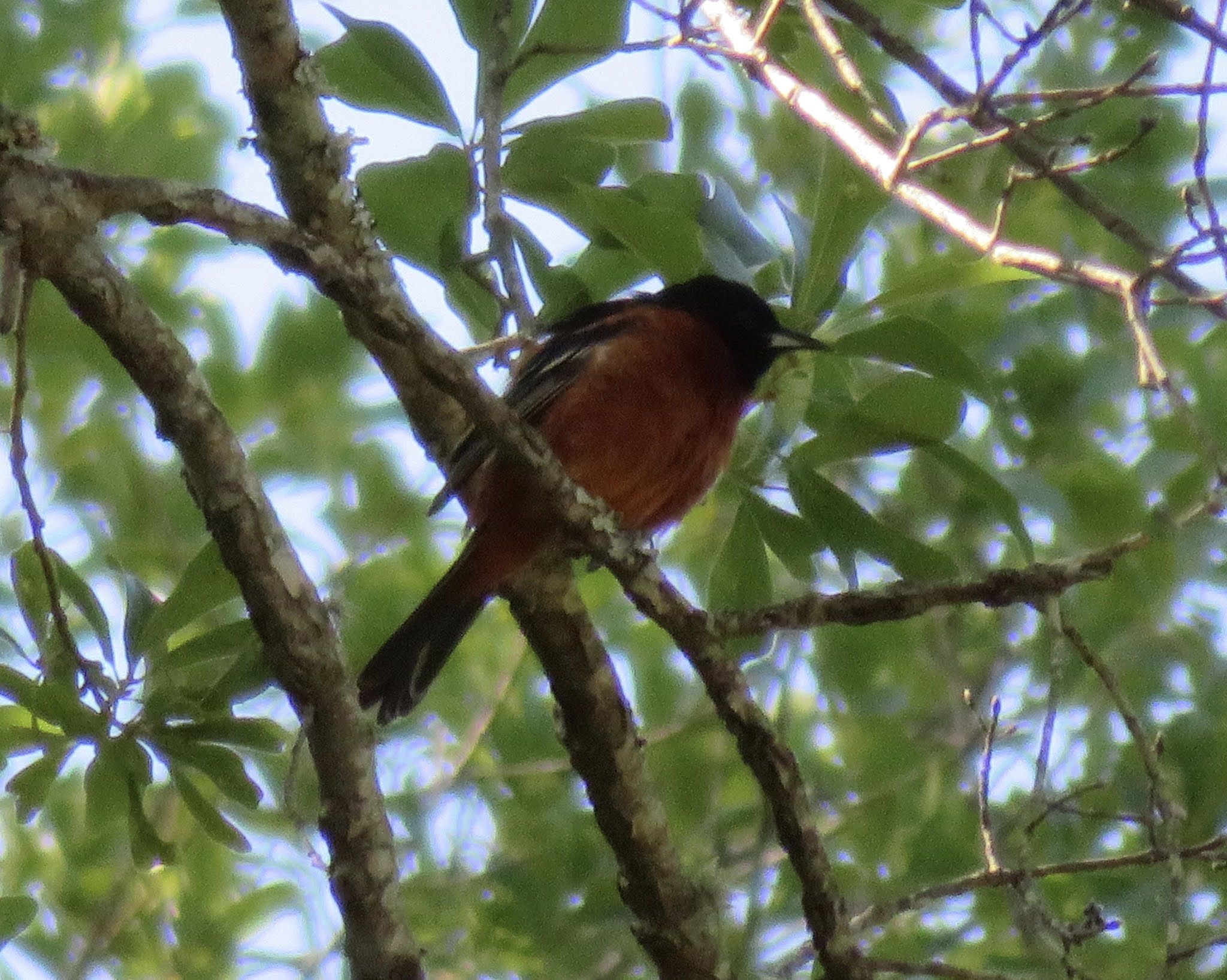
That’s where the orchard oriole comes in.  Most people are unfamiliar with this pretty bird.  I have never set out to find an orchard oriole, which is pronounced by bird guides to be “fairly common” in the upstate.  They are lesser-known cousins of the flashier Baltimore orioles, which are black and brilliant orange, and which migrate through our area on the way to their more northern nesting grounds.  The orchard oriole does nest in upstate South Carolina.  The male orchard looks almost identical to a Baltimore male except in its hue of orange: the Baltimore is bright, but the orchard’s shade is much rustier and more subtle.  Females of both species are greenish-yellow, although Baltimore females may be more orange-tinted.


We’ve unexpectedly run across orchard orioles three times in our years of wildlife-watching adventures:  the first one at Huntington Beach State Park, one while on vacation at Debordieu Colony near Georgetown, and the third one just a few weeks ago on our farm property.  Mike and I were relaxing in the open doorway of the barn, enjoying the afternoon breezes.  I was certainly not particularly expecting to see one of these beauties, but an orchard oriole, like many other less common birds, tends to sneak in when a person has no idea it is coming.  


I saw a brief flash of something moving into the trees to my left; at first I thought it was all black, like a grackle, and then realized that this bird also had some color to it.  It lit on a branch where it could be seen, and a look through binoculars confirmed that it was an oriole.  A second look confirmed its rusty color.  And fortunately it stayed long enough that I could get my sometimes cantankerous camera focused on it and get a picture.  It stayed in the tree for a few minutes - and then it was gone.  If we hadn’t been on the lookout for movement in the trees, we would have never known it had been there. 


Finding something I don’t plan to find at a yard sale is always fun.  And that brief unplanned glimpse of an orchard oriole in our trees was fun also--a splash of beauty in an otherwise ordinary day.  It was all the evidence I needed to keep watching for the unexpected.